
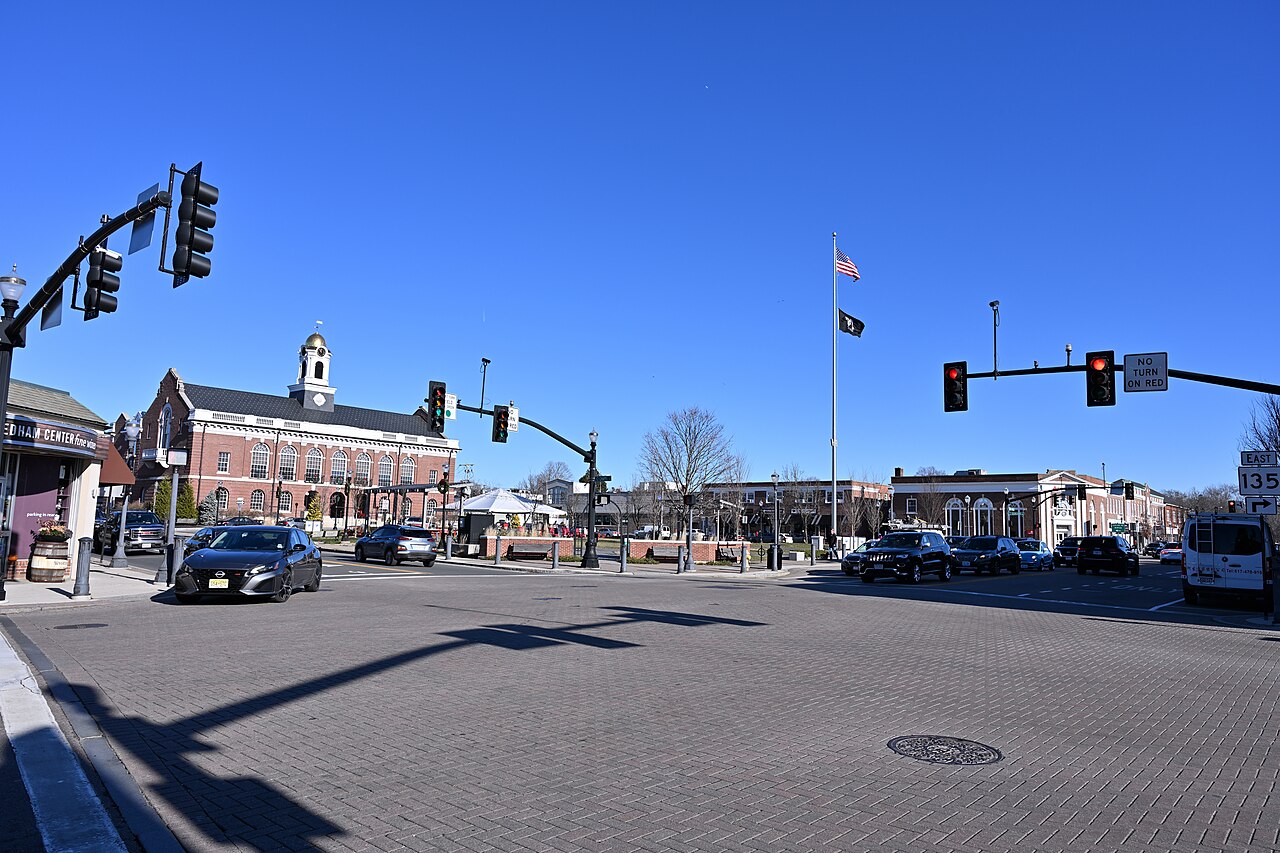
Needham · Single-family homes
Buying a house in Needham: two markets on the same street
Boston sits about ten miles away, and Needham answers it with quiet residential streets, a centre on Great Plain Avenue you can walk to from the blocks around it, and commuter-rail stops of its own. Most of what changes hands here went up when the town filled out after the war: capes, ranches and unassuming colonials sitting on quarter-acre parcels. An increasing share of what changes hands now is the large new house standing where one of those used to be. Two products, two price levels, two different buyers, and choosing between them is the first decision you make rather than a later one.
The numbers
What Needham single-family homes look like right now
Typical value
$1,627,678
Year over year
+6%
Five years
+35.3%
Zillow Home Value Index for single-family homes — a modelled estimate of a typical house's value, not a median of recorded sales. Figures as of August 2026. Source: Zillow research data.
In August 2026, Zillow's modelled estimate of a typical single-family home value in Needham stood at $1,627,678, up 6 percent over the preceding year and 35.3 percent across five years. ZHVI is a model of what a representative house in the town is worth, not a median sale price and not a record of closed transactions. Both figures are worth noticing, but be careful about what they mean in a town like this one. When older houses are steadily replaced by much larger new ones, a town-wide value level can rise partly because the houses themselves have changed, not only because any given house is worth more.
Two markets, and the land underneath both
The postwar house on a quarter-acre lot and the large new colonial standing where one used to be are not variants of a single purchase. One admits you at the bottom of the range and leaves a renovation sitting in your lap; the other arrives complete and charges a substantial premium for being complete. They rarely attract the same buyer and they rarely trade for the same reasons. Underneath both sits one fact: on many streets the land has come to be worth more than the older house on it, which is why the replacement keeps happening. Knowing which side of that you are buying tells you what your next several years of spending will look like.
What the inspector should actually be looking at
On a house from the town's postwar expansion, priced toward the lower end, assume the seller may be pricing the lot rather than the building and that the interior could be largely untouched. Point the inspector at the heating system, the electrical panel and the roof before anyone discusses the finishes, and get a specialist opinion on anything close to the end of its life. Then look outward as well as in. If a neighbouring property is an obvious candidate for replacement, your purchase quietly includes a construction season next door and, when that ends, a taller building with windows facing your garden. A slow walk up and down the street, noting which houses are new, costs nothing and tells you which way the block is going.
What the value figures can and cannot tell you
The modelled estimate covers the whole town and folds both markets into one line, so it cannot tell you the gap between an original house and a finished replacement — which is the number that actually governs your decision here. It says nothing about condition, nothing about lot size, and nothing about what a renovation would cost. And because the composition of the housing stock is itself changing as houses are replaced, a rising town-wide level partly reflects different houses rather than higher prices for the same ones. Use it for direction, and use a street-by-street look plus an inspector for anything you intend to sign.
Questions
What buyers ask me about this segment
- Should I be buying an original house or a new build?
- They are different decisions with different budgets. An original postwar house gets you into the town at a lower number and leaves a renovation in front of you; a finished new build costs substantially more and leaves far less to do. Neither is wrong. What causes trouble is touring both without having decided, because the two rarely satisfy the same buyer and the comparison ends up being between incompatible things.
- Will we need a car, or is the commuter rail enough?
- If two adults are commuting in opposite directions, budget for two cars. The train is genuinely useful but it tends to be the second commute rather than the first: the town's own stops reach South Station, yet the timetable thins out midday and at weekends. Route 128 runs along one edge of Needham and Route 9 is close by, which is why a large share of residents simply drive, often to employers on the highway side.
- Does the value index tell me what a house will sell for?
- No. It is Zillow's modelled estimate of a typical single-family value across the whole town in August 2026, produced by a model rather than assembled from closed sales, and it is not a median sale price. In a town where older houses are steadily replaced with much larger ones, it is particularly poor at pricing one specific property. Treat it as a level and a direction.
Thinking about Needham?
Tell me your budget and timing and I will tell you honestly whether this segment fits — and what it would cost you to be wrong about it.